
Chronology
The South East Asian Refugees
Canada 1975-1991
A Brief Overview
The American involvement in Vietnam began in the aftermath of the Second World War and in the context of the conflict with the Soviet Union which became known as the Cold War. They began providing funds to the French military to support their presence in Vietnam as they fought against forces led by the Communist Party of Vietnam. In 1950, both the Soviet Union and China recognized the Communist-led Democratic Republic of Vietnam based in Hanoi in the north. A little while later, the US and its allies recognized the State of Vietnam based in Saigon in the south.
On 7 May 1954, after a conflict at Dien Bien Phu with the military forces of the North, the French military surrendered. This marked the end of French military involvement in Indochina. At a peace conference in Geneva, the French negotiated a ceasefire agreement with the North. The country was temporarily partitioned at the 17th parallel. Under the 1954 Geneva Accords, civilians were given the opportunity to move freely between the two provisional states for a 300-day period. Elections throughout the country were to be held in 1956 to establish a unified government. Subsequently, the Americans repudiated the agreement since it was signed neither by them nor the South Vietnamese government they supported. By the terms of the Geneva agreement, both Laos and Cambodia became independent.
Thousands of mainly Catholic Vietnamese migrated to the south while supporters of the Communist Party moved to the north during the 300 days. In 1956, the last French soldiers left South Vietnam and the remaining solders from China left the north. In the north, Ho Chi Minh and the Communist Party consolidated power while in the south Ngô Đình Diệm, appointed Prime Minister, consolidated his power. Unification elections were not held.
American direct involvement in Southeast Asia took place in Vietnam, Cambodia, and Laos from November 1, 1955 to the fall of Saigon, South Vietnam on April 30, 1975. The United States sought to replace France as the dominant power in Southeast Asia and under its containment policy sought to prevent the fall of Laos, Cambodia, and South Vietnam to communist forces.
The Vietnam War was fought between North Vietnam, supported by the Soviet Union and China which supplied political support and war materials, and South Vietnam supported by the United States which began by sending military advisors and eventually intervened directly with ground, air, and naval forces. The war was exceedingly destructive, caused massive internal displacements and was extended into both Laos (1968) and Cambodia (1970). A massive North Vietnamese offensive in 1968 (the Tet Offensive) was defeated militarily by US and South Vietnamese forces but destroyed American popular support for the war, leading to an eventual American withdrawal.
On April 30, 1975, North Vietnamese troops entered Saigon marking the end of the Vietnam war. The victorious communist nationalists were ready to punish their enemies, meaning any supporters, officials, or soldiers of the former government. As well, the new government considered members of the professional or business classes, especially if these were part of minority ethnic groups ? in particular the Chinese - as class enemies to be expelled or re-educated, meaning punished in concentration camp-like conditions. In Cambodia, the Khmer Rouge, which took power in 1975 under the leadership of Pol Pot, arrested and executed those who had any connection with the former government, as well as landowners, businessmen, professionals, and intellectuals. The genocide resulted in an estimated 1.5 to 2 million deaths in camps across the country. The deaths represented about one quarter of the population. In 1978, the forces of the now unified Vietnam invaded Cambodia and overthrew the Khmer Rouge. Between 1978 and 1992, there were a succession of governments under the influence of the Vietnamese military occupying the country.
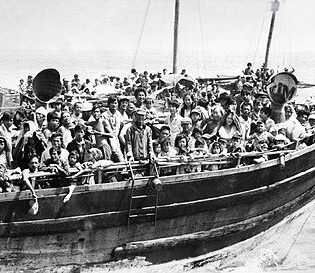
For Canada, the Indochinese Refugee Movement was very important for a number of reasons. It was the largest single refugee resettlement movement to Canada since the post-World War II emptying of displaced person camps in Europe.
During the war, relentless bombing resulted in the destruction of the land and rice fields littered with land mines and contaminated with chemicals and herbicides used to destroy rice and other crops. Due to its strategic importance, Laos became part of the US Secret War and was subjected to a US bombing campaign. Between 1964 and 1973, the U.S. dropped two million tons of bombs on Laos, making it the most heavily bombed country per capita in the world. In 1975, the Pathet Lao, the Lao Communist Party, took power in the country after a civil war with the Royal Lao Army which began in 1960. In the years after 1975, many Vietnamese, Cambodians, and Laotians faced food shortages, severe hunger, and death from disease and starvation.
The flight of refugees from Vietnam, Cambodia and Laos to other countries around the South China Sea, either by boat to harbours in Thailand, Malaysia, Indonesia, China, the Philippines, and Singapore, or overland to Thailand and China, started in April-May 1975 and continued, intermittently, until the early 1990s.
The first major refugee outflow took place in 1975-76, following the communist victories in all three countries. After a short respite during 1977, the refugee outflows again increased rapidly in 1978, both by boat over the South China Sea and across the land borders from Cambodia and the Mekong River from Laos, reaching catastrophic proportions by early 1979. A series of local wars, the reign of terror of the Khmer Rouge in Cambodia, harvest failures, terrible economic conditions, and the persecution of those people who were termed class and ethnic enemies pushed huge numbers of people to embark on terribly dangerous, often deadly, journeys from their homelands. The international community managed to agree to resolve this major international humanitarian and political crisis in Southeast Asia in July 1979, through resettlement in developed countries.
By the end of 1980, the number of camps was dramatically reduced, and the refugee crisis appeared, at first, to be resolved. By 1981, the three refugee source countries were on a slow, uneven road to internal stabilization. However, through the early 1980s, large parts of their populations felt under pressure and continued to escape to surrounding countries and then to resettlement in the West. By the late 1980s, however, with Vietnam, Laos, and Cambodia largely stabilized, it became evident that an increasing proportion of those arriving in refugee camps were motivated by family and economic factors. In 1989, through the international Comprehensive Plan of Action, the international community introduced screening for refugee status and agreed to phase out third country resettlement as the principal solution to population outflows in Southeast Asia.
For Canada, the Indochinese Refugee Movement was very important for a number of reasons. It was the largest single refugee resettlement movement to Canada since the post-World War II emptying of displaced person camps in Europe. It was the first mass refugee movement that resettled visible minority populations that were culturally, ethnically and linguistically very different from the Canadian mainstream. It was the first refugee movement in which ordinary Canadians, the Canadian people, played a decisive role through the newly created private and group sponsorship vehicles. The extraordinary role of ordinary Canadians in resolving the Southeast Asian refugee crisis was recognized internationally when the UN awarded the Nansen Medal (the highest international honour for assisting refugees) to the people of Canada in 1986.
To meet the administrative and operational challenges of the Indochinese refugee movement, Canada's public servants created several innovative solutions (private and group sponsorships, designated classes, and the Refugee Matching Centre) that are still in place. Finally, and most importantly, the successful integration of Vietnamese, Cambodian, and Laotian refugees into Canadian society has demonstrated that refugees can, and do, make real contributions to Canada, and that they and their children can and do become committed, productive, patriotic Canadians.
Chronology
1975-1978
Communist Pathet Lao is victorious in Laos, marches into Vientiane. Communist Khmer Rouge is victorious in Cambodia, marches into Phnom Penh. North Vietnamese forces besiege Saigon.
The Baby lifts
Two flights of Vietnamese and Cambodian orphan children from Saigon under siege arrive on 6 and 12 April destined to adoptive parents in Canada. This is the first major demonstration of effective cooperation to help the refugees by federal and provincial Canadian officials, NGOs and private individuals.
Promise of Visa Letters
Letters are sent from the Canadian Embassy in Saigon under siege to 3,500 families with relatives in Canada including some 15,000 persons, promising them a Canadian visa if they can get to a Canadian diplomatic office anywhere even after the fall of Saigon.
Fall of Saigon
Panic in Saigon, chaotic evacuation of US Embassy. Canadian Embassy evacuated in disciplined manner.
Saigon falls to North Vietnamese forces supported by the Viet Cong on April 30.
Canada will resettle Vietnamese and Cambodian refugees
Immigration Minister Robert Andras announces that Canada will resettle Vietnamese and Cambodian refugees, including any with relatives in Canada plus 3,000 refugees without relatives in Canada. He carefully emphasizes that Canada’s decision is humanitarian and non-political.
Some 140,000 refugees escape from Vietnam, mostly by boats, the majority are former officials of the South Vietnamese government, military personnel, middle class people and members of the Chinese minority; a large number of hill tribes people (Hmong), middle class Laotians and Chinese minority people escape from Laos to Thailand across the Mekong River; initially, relatively few refugees can leave Cambodia, the Khmer Rouge manages to close Cambodian borders very rapidly.
Vietnamese refugees are transported to the USA’s Clark Air Force Base in the Philippines and thence to Guam and the continental USA. Numbers of boat refugees manage to make it to Hong Kong. Canadian teams select refugees in Hong Kong, Guam and the continental USA.
Canada selects and transports to Canada 6,353 refugees in 1975-76, including 4,500 immediately after the fall of Saigon. Most of these are selected through Hong Kong, Guam and military bases across the southern USA.
Re-education camps with high mortality rates are established in Vietnam, especially targeting officials, army officers of the old regime and middle class people.
There are reports of Cambodian refugees refouled to Cambodia by Thai authorities and killed by the Khmer Rouge.
Proclamation of the Lao Peoples Democratic Republic is followed by mass arrests, repression and establishment of “seminars” (re-education camps). Many Laotian refugees who had returned to Laos from Thailand (often forced to return through UNHCR repatriation programs) end up in these re-education camps. By the end of 1976, it is estimated that up to 15,000 Laotians are in re-education camps.
During 1976, 5,619 Vietnamese boat people arrive in neighbouring countries around the South China Sea. In comparison to 1975 this is a relatively small number and there is hope in Canada as well as other Western countries that the outflow of Indochinese refugees may be coming to an end.
Poor weather, bad harvests and economic collapse in Vietnam.
In the course of 1977, against previous hopes, refugee outflows pick up and 21,000 boat people arrive in S.E. Asian countries. There is fighting between Vietnam and Cambodia. 854 refugees are resettled by Canada during 1977 and Canada agrees to contribute to resolving refugee crisis by accepting 450 additional boat people.
Canadian municipalities, NGOs, media become gradually more aware of the increasing crisis. The Mayor of Windsor Ont. establishes a committee to help resettle Indochinese refugees.
With increasing Chinese-Vietnamese tensions, there are increasing pressures by Vietnamese authorities on Vietnam’s Chinese community to leave the country.
The government approves the Immigration department’s plan to establish the Private Refugees Sponsorship Program. Consultations are started with potential sponsoring organizations. Canada agrees to accept 50 “Small Boat Escapee” families per month.
The Immigration department starts to design the Small Boat Escapee Designated Class which will eventually become the Indochinese Designated Class including all Vietnamese, Cambodian and Laotian refugees. With this class, Indochinese refugees no longer need to satisfy the Convention Refugee definition before being accepted by Canada.
Cabinet instructs the Canadian Employment and Immigration Commission (CEIC) to promote involvement of Canadians in assisting Indochinese refugees. Briefings are held across Canada on the new private/group sponsorship program
Some large freighters full of refugees who boarded in Vietnam arrive in ports around the South China Sea. From Canada’s perspective, the most important of these is the “Hai Hong” (original destination Hong Kong, pushed off to the high seas by the Indonesian Navy, finally anchored off Port Klang, Malaysia; Malaysian authorities do not allow the refugees on land). Canada leads the international community in rescuing the Hai Hong refugees, accepting 600. In December, on arrival in Canada, the Hai Hong refugees are greeted by the Federal and Quebec Immigration Ministers at CFB Longue Pointe in Montreal. The media coverage of the Hai Hong incident strongly raises awareness of the plight of boat people across the country.
Bangkok Visa Office opens to select Laotian and Cambodian refugees escaping overland to Thailand. Initially, it is to resettle 20 Overland Refugee families per month.
Indochinese Designated Class Regulation comes into effect. UNHCR hosts an emergency meeting in Geneva to attempt to resolve the Indochinese refugee crisis. Canada’s Cabinet agrees to establish an Annual Refugee Plan. 5,000 Indochinese are to be admitted under the 1979 plan. The Mennonite Church seeks a refugee sponsorship agreement with the Immigration department.
By the end of 1978, 106,489 boat people had arrived in South East Asian countries of first asylum.
Number of Indochinese refugees resettled in Canada: 9,151
During the years following the fall of Saigon, Phnom Penh and Vientiane until the end of 1978, 9,151 Vietnamese, Laotian and Cambodian refugees were resettled in Canada.
1979-1980
Vietnamese forces occupy Phnom Penh
Vietnamese forces occupy Phnom Penh, install the Heng Samrin regime in in Cambodia. This is the end of the genocidal Khmer Rouge terror regime. Khmer Rouge cadres flee to western Cambodia many cross the Thai border among massive influx of Cambodian refugees into Thailand. Some 150,000 Cambodians cross into Thailand, but 100,000 are pushed back into Cambodia by the Thai authorities. Thousands of refugees perish along the Thai-Cambodian land border in the first half of 1979.
Sino-Vietnamese war
Sino-Vietnamese war, more than 200,000 ethnic Chinese flee Vietnam over the land border into China. Others take to the high seas in rickety fishing boats or old freighters in rapidly increasing numbers.
The Mennonite Central Committee signs a sponsorship agreement with CEIC which becomes the model for all subsequent group sponsorship agreements. Other faith- based organizations follow suit rapidly. Visa offices in Hong Kong and Singapore put thousands of refugees into processing to meet the requirements of the 1979 Refugee Plan.
Dramatic increase of Vietnamese boat people reaching neighbouring countries continues: April-26,602, May-51,139, June-56,941. Many perish on the high seas, often falling victim to pirates.
A Refugee Matching Centre is established at Canada Immigration HQ in Ottawa to pair refugees with sponsors and destine unsponsored refugees to communities across Canada.
Federal Election. The Progressive Conservative Party forms a minority government. Under PM Joe Clark’s direction, Ministers Flora MacDonald (External Affairs) and Ron Atkey (Employment and Immigration) immediately assume active leadership on the Indochinese refugee file.
The plight of the refugees becomes very high profile in Canada. TV reporting brings the humanitarian tragedy into Canadian homes from coast to coast.
PC government increases Canada’s annual Indochinese refugee target from 5,000 to 8,000
The new PC government increases Canada’s annual Indochinese refugee target from 5,000 to 8,000 (June 18) and asks the voluntary private sector to sponsor an additional 4,000 refugees under the new private sponsorship program. The reaction of the private sector exceeds government expectations: Operation Lifeline is founded by York University Professor Howard Adelman; Project 4000 is founded by Ottawa Mayor Marion Dewar; Mennonites, Christian Reformed, Lutherans and Presbyterians sponsor 1,604 refugees.
Political crisis in SE Asia
Political crisis in SE Asia. With boat arrivals increasing rapidly, Thailand, Malaysia, Indonesia, Philippines and Singapore announce that they will accept no more refugees, putting pressure on the rest of the world to find a solution to the SE Asia Refugee emergency.
Cabinet decides to accept 50,000 refugees
Cabinet decides to accept 50,000 refugees (July16). Government charters 76 flights and establishes staging areas (reception centres) at Canadian Forces Bases (CFB) in the east and west of the country at CFB Longue Pointe, Montreal (Aug 7) and CFB Griesbach, Edmonton (Aug 13). Arrival rate increased from 1,000 a month to 3,000 to 5,000.
UN Secretary General calls an International Conference in Geneva
In order to attempt to resolve the crisis on the South China Sea, the UN Secretary General calls an International Conference in Geneva. Canada’s governments, media and the Canadian public react to the international crisis by showing genuine broad- based humanitarian concern for the plight of the boat people. With the political leadership of PM Clark and the active policy leadership of ministers MacDonald and Atkey, the government announces that the resettlement of 50,000 Indochinese refugees will consist of the 8,000 already announced plus 21,000 privately sponsored and 21,000 government assisted refugees.
Flora MacDonald outlines Canada’s plans
At the UN Geneva Conference (July 20-22) Flora MacDonald outlines Canada’s plans, placing emphasis on the role of the voluntary sector in resettling refugees. (One government assisted refugee will be accepted for every refugee that is privately sponsored). The MacDonald speech is instrumental in starting an avalanche of commitments by many countries and is an important factor in resolving the international refugee crisis. By 31 July, 747 groups in Canada have sponsored 3,800 refugees.
Developed countries agree to resettle refugees rapidly
Major result of Geneva conference is effective burden sharing: developed countries agree to resettle refugees rapidly, in an orderly manner, sharing the burden with lesser developed first countries of asylum. Canada plays a major role in reaching this result.
11 Canadian military flights from Hong King transport 2,000 refugees to Canada.
First refugee flights under Canada’s new commitments land are directed to Vancouver and other cities.
First refugee flights under Canada’s new commitments land are directed to Vancouver and other cities. As of August 8 in Montreal and August 14 in Edmonton the refugees are received, welcomed, documented and allowed to rest for a few days at CFB Longue Pointe and CFB Griesbach before proceeding to their sponsors and destinations across the country. The actions of Canada’s military under extreme pressure in receiving, accommodating and arranging the onward transportation of the refugees are exemplary. It should be noted that receiving the Hai Hong refugees in November 1978 at CFB Longue Pointe provided useful experience to the military in managing the much greater influx of 1979-80.
The Refugee Matching Centre is redesigned to handle 5,000 refugee arrivals a month
The Refugee Matching Centre is redesigned to handle 5,000 refugee arrivals a month through the use of computer supported matching of refugees with destination communities. This is a very early innovative use of computers to resolve a complex administrative problem. By August 30, 1,893 private sponsorships were received for 10,643 refugees. Fifty-five Refugee Liaison Officers are recruited in communities across the country to facilitate and coordinate reception and resettlement activities
Very rapid continuing commitments by Canada’s private sponsors: 3,122 private sponsorships received for 17,147 refugees.
Despite the earlier pushback into Cambodia by Thai authorities, large numbers of Cambodians mass on the Thai-Cambodian border
Despite the earlier pushback into Cambodia by Thai authorities, large numbers of Cambodians mass on the Thai-Cambodian border, pushing into Thailand and being accommodated in enormous encampments. It is estimated that Thai authorities, aided by international organizations are faced with 600,000 and 800,000 semi-starving Cambodian refugees. Canadian and Quebec immigration officials, based in Bangkok, are actively selecting large numbers of refugees from the Thai camps.
By the end of November, 4,622 private sponsorships for 25,059 refugees exceed the government target of 21,000 for private sponsorships.
Clark government attempts to hold refugee numbers to its commitment of 50,000
Clark government attempts to hold refugee numbers to its commitment of 50,000, despite the fact that private sponsorships considerably outstrip the 21,000 allotted spaces and refugee arrivals in Quebec lag behind the numbers allotted to and committed to by Quebec Immigration. Negative reaction on the part of the refugee advocate community and Quebec authorities: possibility of social and political problems.
Clark government loses confidence vote and falls (but not over the refugee issue). New federal election is called for Feb. 1980
Total Indochinese refugee arrivals in 1979 - privately sponsored 8,211, family sponsored 615, government assisted 10,043. TOTAL: 23,583
6,003 private sponsorships for 33,114 refugees.
Clark government loses election to the Trudeau Liberals
Clark government loses election to the Trudeau Liberals. Lloyd Axworthy becomes Minister of Employment and Immigration.
Minister Axworthy increases the 1979-1980 Indochinese refugee target to 60,000 with 10,000 additional government assisted refugees, thereby addressing concerns that the government is failing to do its share and ensuring that Quebec receives its allotted share of refugees.
Canadian officials continue to scour refugee camps in countries around the South China Sea (Hong Kong, Malaysia, Thailand, Indonesia. Philippines), selecting refugees and arranging their transportation to Canada. Refugees are matched with receiving sponsors and communities, are welcomed at the two CFB staging areas and arrive rapidly at their destination communities where sponsors and federal Refugee Liaison Officers facilitate their reception and initial settlement.
By the end of 1980 7,675 sponsorships have been filed for 39,904 refugees, many of whom arrive in Canada in 1981.
Charter flight 181 brings the last of 60,049 refugees to Montreal and thence to the CFB Longue Pointe staging area. The symbolic last family is taken to Ottawa and welcomed by Prime Minister Pierre Elliott Trudeau.
Number of Indochinese Refugee arrivals in Canada in 1979-80:Privately sponsored 32,281, relative sponsored 1790, and government assisted 25,978TOTAL 60,049
1981-1991
During the decade of the 1980s, the processing of South East Asian refugees for resettlement in Canada continued mainly, but not only, through Canadian diplomatic missions around the South China Sea, including Hong Kong, Singapore, Bangkok, Manila and the newly opened visa office in Kuala Lumpur. All these visa offices used refugee selection and processing procedures established during the “heroic” period of 1978 to 1980. As the decade progressed and many Vietnamese, Cambodian and Laotian refugees became established in Canada, family reunification became a progressively greater part of the movement. At the same time, refugees newly arrived in first countries of asylum continued to be accepted for resettlement in Canada as members of a designated class and group/private sponsorships had become a routine part of South East Asian refugee selection and resettlement in Canada.
As the 1980s progressed, official voices were raised both by the UNHCR and in Western capitals that third country resettlement should no longer be the preferred durable solution for South East Asian refugees. It was felt by many Western politicians and migration professionals that once the political and humanitarian emergency of 1978-80 was resolved through third country resettlement and the refugees’ home countries became stabilized, the preferred solutions should be repatriation and local integration rather than third country resettlement. Canada was of two minds on this issue. On the one hand, our well-established refugee selection and resettlement practices demonstrated that Canada’s approach was a humane way of dealing with large refugee outflows.
Yet on the other hand, by the late 1980s it was becoming clear that the relatively easy immigration possibility offered through refugee resettlement acted as a “pull factor” for non-refugee immigrants, who, as members of a designated class, did not have to satisfy Convention Refugee criteria. In Canada, the Annual Refugee Plan, established as a regulatory management instrument at the start of the South East Asian refugee emergency, acted as a break on non-refugees using the Indochinese Designated Class as an immigration tool. Internationally, Canada was an active participant in the negotiations that resulted in the Comprehensive Plan of Action of 1989 that put an international break on continued refugee/migration outflows in South East Asia. Even though the Indochinese Designated Class remained in place for several more years, its reach was gradually reduced. By 1994, the South East Asian refugee movement to Canada was effectively over.
Statistics of Regugees in Canada in 1991
Vietnamese in Canada – 94,265, Cambodians in Canada – 18,260, Laotians in Canada - 14,840